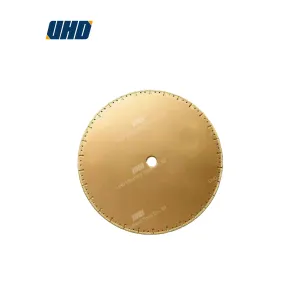
In today's fast-evolving industrial landscape, efficiency and durability stand as pillars of sustained productivity. Brazed diamond cutting blades have rapidly emerged as a preferred tool, offering unmatched performance by combining cutting and grinding functions in a single unit. This article delves into the technical superiority and market dynamics driving the adoption of brazed diamond cutting blades, illuminating their pivotal role across machinery manufacturing, construction, and other heavy industries.
Unlike traditional diamond blades, brazed diamond cutting blades integrate diamond segments directly onto the metal core using a high-temperature brazing process. This metallurgical bond enables a unique one-piece structure that excels in both cutting and grinding tasks. Typical blades showcase diamond grit sizes ranging from 30 to 80 mesh, optimized for different materials such as metals, ceramics, and composites.
Key technical advantages include:
Traditional resin-bonded and electroplated diamond blades are limited by weaker adhesion between diamonds and the blade body. Resin bonds often degrade quickly under high temperatures, and electroplating creates relatively thin diamond layers prone to early wear. Brazing, by contrast, forms a robust metal-to-metal bond at temperatures exceeding 800°C, resulting in a structural integrity that maintains consistent diamond exposure throughout prolonged use.
In a comparative study conducted by the International Cutting Tools Institute in 2023, brazed blades outperformed conventional resin-bonded blades by 30-40% in cutting speed and maintained sharper edges over 20% longer operational hours.
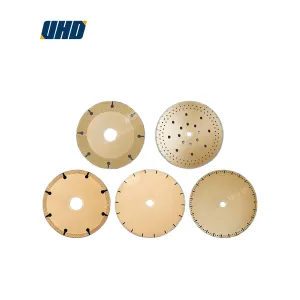
Brazed diamond cutting blades come in a broad range of diameters—from 100mm for precision tooling up to 600mm for heavy-duty machinery applications. Their customizable thickness and diamond grit sizes make them adaptable to various materials: stainless steel, titanium alloys, granite, reinforced concrete, and ceramics.
This versatility enables industries such as automotive, aerospace, mining, and construction to optimize their toolkits, reduce downtime, and improve surface finish quality. For example, blade thicknesses between 1.5mm to 3.5mm are commonly selected based on the balance needed between cutting speed and edge durability.
The global market for diamond cutting tools is projected to grow at a compound annual growth rate (CAGR) of approximately 7% from 2024 to 2029, spurred by increasing automation and demand for sustainable manufacturing practices.
Brazed diamond blades are a direct beneficiary of these trends due to their:
Notable applications include:
Rigorous quality control protocols ensure that brazed diamond blades meet international standards such as ISO seismic and ASTM F316 where applicable. Material traceability, hardness testing, and brazing fatigue analysis are standard, guaranteeing consistent blade performance across batches.
These measures contribute to blades that withstand demanding industrial conditions, offering reliability essential for global clients whose operations depend on minimal interruptions and maximum tool uptime.
As industries become more specialized, the trend toward customization is gaining momentum. Manufacturers now offer tailored blade geometries, diamond grit compositions, and bonding techniques designed for unique workflows and materials.
Integrated services such as predictive maintenance analytics and on-site performance consulting further augment the value proposition of brazed diamond blades, creating a comprehensive solution that not only cuts but actively optimizes industrial workflows.

 196
|
196
|
 Brazed diamond grinding wheels
Environmental friendly manufacturing
Low - dust grinding wheels
Ductile iron processing
Green manufacturing technology
490
|
Manual diamond grinding wheels
High - efficiency grinding solutions
Industrial dust control
Metal processing safety
Resin bond replacement
90
|
vacuum brazed diamond wheel
cast iron grinding solution
automatic grinding diamond wheel
high precision grinding
superhard tool replacement
228
|
diamond saw blade cutting technology
stone cutting techniques
concrete cutting parameters
dry vs wet cutting
diamond blade wear resistance
129
|
brazed diamond wheels
low dust manufacturing
sustainable manufacturing technology
wear-resistant grinding wheels
green manufacturing solutions
Brazed diamond grinding wheels
Environmental friendly manufacturing
Low - dust grinding wheels
Ductile iron processing
Green manufacturing technology
490
|
Manual diamond grinding wheels
High - efficiency grinding solutions
Industrial dust control
Metal processing safety
Resin bond replacement
90
|
vacuum brazed diamond wheel
cast iron grinding solution
automatic grinding diamond wheel
high precision grinding
superhard tool replacement
228
|
diamond saw blade cutting technology
stone cutting techniques
concrete cutting parameters
dry vs wet cutting
diamond blade wear resistance
129
|
brazed diamond wheels
low dust manufacturing
sustainable manufacturing technology
wear-resistant grinding wheels
green manufacturing solutions






.png?x-oss-process=image/resize,m_fill,h_300,w_300/format,webp)

.png?x-oss-process=image/resize,m_fill,h_300,w_300/format,webp)