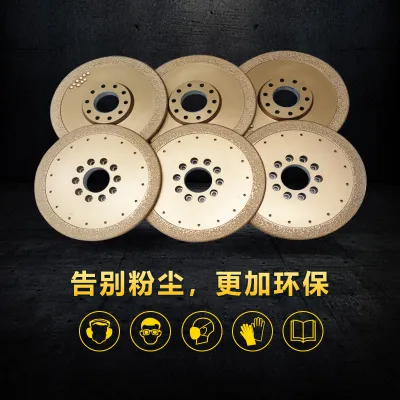
If you're involved in precision machining—especially with ductile iron components—you know how critical it is to select the right diamond grinding wheel. A poor choice doesn’t just slow down production—it increases wear on your equipment, raises dust emissions, and drives up long-term costs.
When evaluating diamond wheels, focus on three key specs:
According to a 2023 study by the International Association of Abrasives, brazed diamond wheels reduce tool change frequency by up to 40% compared to traditional bonded types—while maintaining consistent surface accuracy across 10,000+ parts per batch.
For ductile iron applications (common in automotive and aerospace), use medium-grain (80–120 mesh) brazed wheels with open structure. This configuration ensures optimal heat dissipation, minimizes clogging, and extends wheel life by 25–35% versus standard options.
Case in point: One German OEM saw their grinding cycle time drop from 4.7 minutes to 3.2 minutes after switching to UHD’s custom-configured brazed diamond wheels. They also reported a 30% reduction in abrasive dust emissions—critical for compliance with EU environmental standards.
UHD’s proprietary brazing process delivers consistent grain retention and minimal vibration during operation—even at speeds over 100 m/s. This translates into:
Engineers who’ve tested UHD products often highlight one thing: they don’t just meet expectations—they exceed them consistently, even under harsh industrial conditions.
If you’re ready to move beyond trial-and-error selection and start making data-driven decisions, explore our full range of UHD brazed diamond grinding wheels tailored for ductile iron, stainless steel, and other hard-to-machine materials.
Have questions about grain size, bond type, or compatibility with your specific CNC grinder? Drop them below—we respond within 24 hours and may feature your query in our next technical deep-dive.

 321
|
321
|
 UDD020 core bit
vacuum brazed diamond bit
high-efficiency drilling tool
dry drilling bit
diamond bit customization
69
|
UHD brazed diamond grinding rod
vacuum brazing grinding tools
diamond grinding rod applications
precision cast iron finishing
high-performance grinding solutions
287
|
vacuum brazed drill bits
diamond core drill bits
abrasive grade impact
drill bit durability
dry drilling tools
38
|
Diamond wheel selection
Brazed diamond wheel parameters
Ductile iron processing wheel configuration
Wheel aperture selection
Maximum speed matching
419
|
Diamond wheels
Dust control
Industrial grinding
Metal processing solutions
Superhard tools
UDD020 core bit
vacuum brazed diamond bit
high-efficiency drilling tool
dry drilling bit
diamond bit customization
69
|
UHD brazed diamond grinding rod
vacuum brazing grinding tools
diamond grinding rod applications
precision cast iron finishing
high-performance grinding solutions
287
|
vacuum brazed drill bits
diamond core drill bits
abrasive grade impact
drill bit durability
dry drilling tools
38
|
Diamond wheel selection
Brazed diamond wheel parameters
Ductile iron processing wheel configuration
Wheel aperture selection
Maximum speed matching
419
|
Diamond wheels
Dust control
Industrial grinding
Metal processing solutions
Superhard tools






.png?x-oss-process=image/resize,m_fill,h_300,w_300/format,webp)