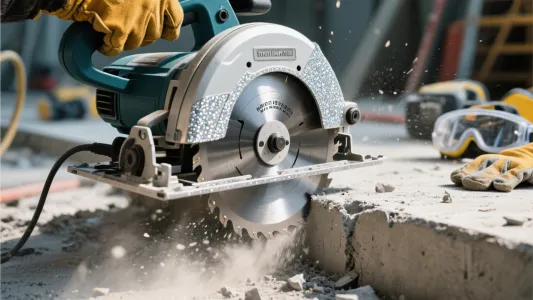
Vacuum Brazed Diamond Grinding Wheels for Smart Manufacturing: Boosting Metalworking Efficiency
2026-02-20
Technical article
In the era of smart manufacturing, metalworking productivity is increasingly limited by the instability, short service life, and high maintenance demands of conventional electroplated grinding wheels. Vacuum brazed diamond grinding wheels are emerging as a high-performance alternative by delivering stronger grit retention, more consistent cutting behavior, and longer usable life under automated, multi-axis conditions. This article examines the technical fundamentals behind ultra-high-definition vacuum brazing, including braze-layer bonding strength and geometry-optimized wheel structures that improve chip evacuation and thermal control. It also highlights real-world performance in cast iron machining where dimensional accuracy and process stability are critical, and explains how extended wheel life can translate into fewer tool changes and more predictable cycle times. In addition, the article outlines the sustainability benefits of longer-lasting tools and cleaner, more controllable grinding processes that align with green manufacturing goals. Finally, it introduces customization capabilities across UDW-series sizes and special-duty applications—inviting manufacturers to experience the efficiency difference and strengthen their metalworking operations through a more reliable automated grinding solution.
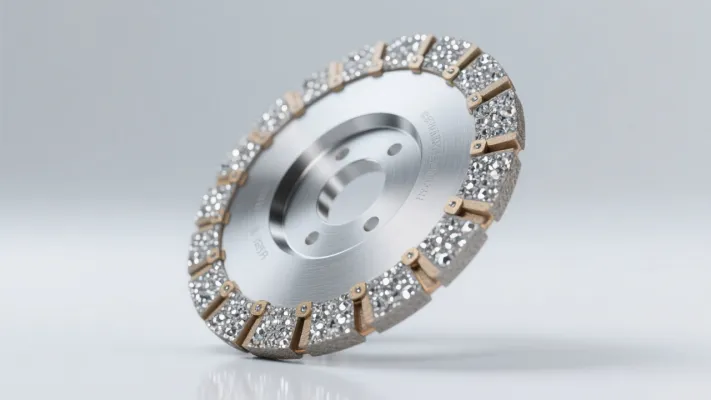
Vacuum Brazed Diamond Grinding Wheels in Smart Manufacturing: A Practical Way to Raise Metalworking Throughput
In today’s smart manufacturing environment—where multi-axis automation, tool condition monitoring, and predictable cycle times are no longer “nice to have”—abrasive tools are increasingly judged by one metric: stable productivity at scale. Vacuum brazed diamond grinding wheels are emerging as a high-confidence upgrade for metal processors who need consistent grinding behavior, fewer tool changes, and cleaner operations.
Among them, Henan Youde Superhard Tools has brought to market high-performance UDW-series vacuum brazed diamond wheels for automated grinding lines—positioned as a robust alternative to conventional electroplated wheels when stability and lifespan are critical.
SEO focus: vacuum brazed diamond grinding wheel, vacuum brazed diamond wheel for CNC, automatic grinding solution, electroplated vs vacuum brazed wheel, cast iron grinding diamond wheel, superhard tools for smart manufacturing
1) The Smart Manufacturing Bottleneck: When the Wheel Can’t Keep Up With the Cell
Automated grinding cells are designed around repeatable motion, controlled contact pressure, and a known removal rate. Yet many workshops still rely on wheel technologies that were never built for high-duty automation. Common pain points reported by production teams include:
- Short effective wheel life: frequent wheel replacement interrupts unattended operation and reduces OEE.
- Unstable cutting performance: removal rate drifts, surface quality becomes inconsistent, and rework increases.
- Higher maintenance and setup cost: more dressing, more calibration, more operator intervention.
- Heat and burr risk: thermal damage can rise when abrasive exposure becomes uneven or loading occurs.
In many plants, electroplated diamond wheels deliver strong initial sharpness but can become a limiting factor in automation due to single-layer abrasive loss and rapid performance fade. Smart manufacturing doesn’t forgive variability—especially when grinding is upstream of inspection, assembly, or coating.
2) What Makes Vacuum Brazed Diamond Wheels Different (and More Predictable)
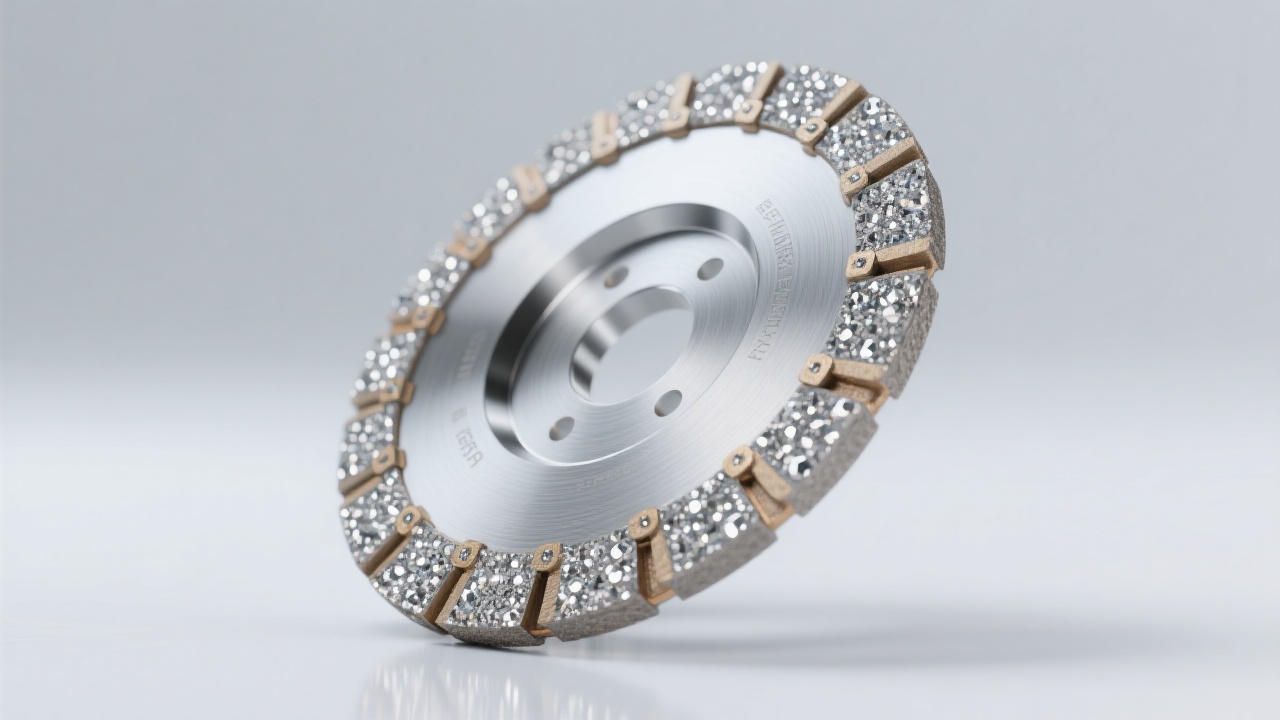
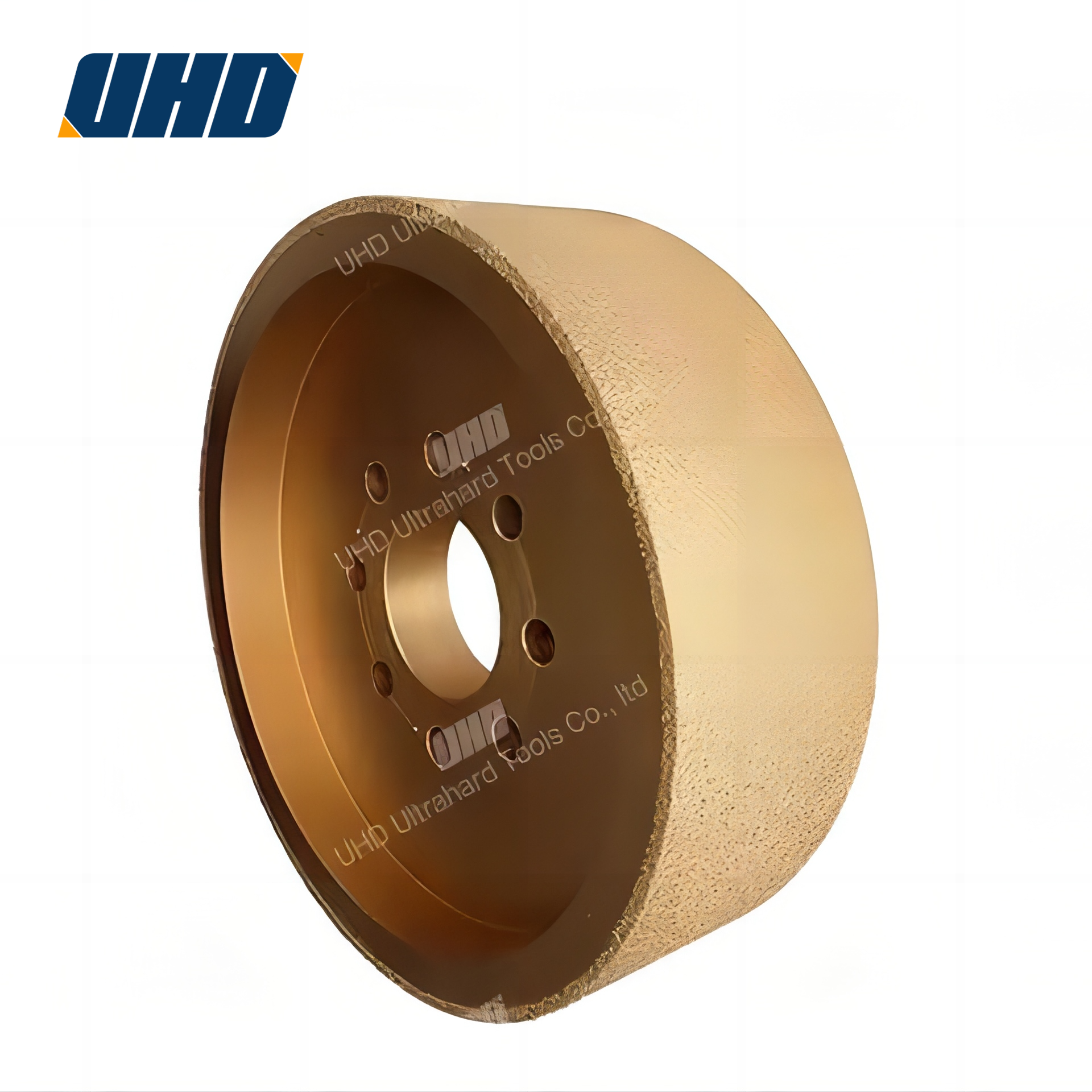
Vacuum brazing is not simply “another bonding method.” It changes how diamond grains are held, how chip space is maintained, and how the wheel behaves under high-load automation. In typical vacuum brazed designs, diamond grains are metallurgically bonded to the substrate, creating a strong interface that resists pull-out and supports stable cutting.
Core Technical Advantages Seen in Production
Stronger grain retention helps maintain a consistent removal rate under constant-pressure or constant-feed strategies.
More open cutting structure improves chip evacuation, which can reduce loading and heat buildup during continuous cycles.
Geometry-optimized profiles (for example, rim designs tailored for multi-axis paths) help keep contact consistent across complex surfaces.
Automation-friendly stability supports longer unattended runs, fewer stoppages, and more predictable tool-change planning.
For automated grinding lines, the practical benefit is straightforward: less drift over time. When tool behavior stays consistent, it becomes easier to standardize process windows, reduce inspection pressure, and keep takt time under control.
3) Cast Iron Grinding: Where Stability and Edge Quality Matter
Cast iron remains a core material across automotive components, pump bodies, machine tool structures, and industrial hardware. It is also unforgiving: graphite structure, intermittent cutting conditions, and dust-like chips can challenge grinding consistency—especially in high-throughput environments.
Typical Shop-Floor Outcomes (Reference Ranges)
Based on common industrial benchmarks observed when upgrading from electroplated diamond wheels to well-designed vacuum brazed diamond wheels in automated grinding:
- Tool life: often improves by 2.0× to 4.0× (depending on part geometry, coolant strategy, and removal rate).
- Cycle time: can be reduced by 10% to 25% when higher sustained MRR is achievable without overheating.
- Wheel change frequency: typically drops by 30% to 60%, supporting longer unattended shifts.
- Surface consistency: fewer outliers in Ra due to steadier cutting action over longer runs (process-dependent).
Note: values are realistic reference ranges used in process planning; final results depend on wheel specification, grit size, bond design, spindle power, and fixture rigidity.
For integrators and production engineers, the significance is not only “more life.” It is the ability to hold a stable grinding window—which directly reduces rework, protects downstream operations, and improves line balancing.
4) Environmental and Sustainability Gains: Cleaner Runs, Less Waste
Green manufacturing is no longer limited to corporate reporting—it affects supplier audits, customer qualification, and sometimes even tender requirements. Grinding operations can contribute to waste through frequent wheel disposal, high consumable turnover, and unstable processes that generate scrap.
Lower consumable waste
Extending wheel life by 2–4× can directly reduce wheel disposal volume and packaging waste, supporting internal ESG targets and customer compliance checks.
More stable energy use
Consistent cutting performance helps keep spindle load more predictable. In many continuous lines, steadier loads translate into fewer peak-power events and smoother thermal behavior.
Less rework and scrap
When the wheel maintains sharpness and chip space, it can reduce heat-related defects and surface inconsistency—common hidden drivers of scrap rates in automated cells.
5) Customization for Multi-Axis Equipment: Why “Fit” Is a Productivity Lever
Smart factories rarely run a single standard part. They run families of parts, frequent changeovers, and multi-axis paths that shift contact conditions constantly. That makes wheel specification—dimensions, grit, rim width, and profile—an engineering decision, not a procurement checkbox.
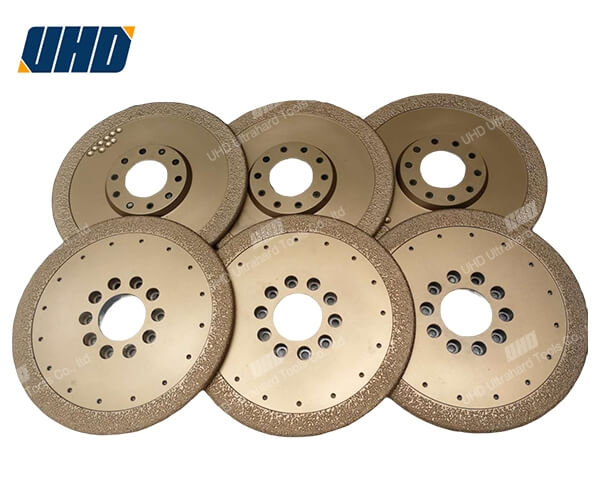
UDW Series: Typical Customization Points for Automated Grinding
- Wheel diameter and thickness matched to spindle power and guarding constraints.
- Profile and geometry optimized for 4/5-axis toolpaths and consistent contact patch.
- Grit size strategy tuned for the balance between finish and removal rate.
- Workpiece material targeting (e.g., cast iron variants and hardness ranges) to stabilize wear behavior.
- Coolant compatibility aligned with wet or near-dry process requirements.
For manufacturers considering a line upgrade, customizing the wheel to the process is one of the most direct ways to experience the efficiency difference—not in theory, but in the daily reality of tool-change intervals, surface repeatability, and cell uptime.
6) Electroplated vs. Vacuum Brazed: A Data-Driven Comparison for Decision Makers
Buyers often ask for a simple rule: “Which wheel is better?” In practice, the decision should be framed as: which wheel keeps the automated process stable for longer under real production constraints.
| Evaluation Item |
Electroplated Diamond Wheel (Typical) |
Vacuum Brazed Diamond Wheel (Typical) |
| Performance stability over time |
Strong initial sharpness; faster decline as grains are lost |
More consistent cutting behavior across longer runs |
| Typical tool life (reference) |
Baseline |
2–4× longer in many automated metal grinding scenarios |
| Changeover frequency impact |
More frequent wheel swaps; lower unattended runtime |
Fewer stops; easier predictive maintenance scheduling |
| Cycle time potential (reference) |
Often limited by heat/loading and performance fade |
10–25% shorter when process can sustain higher MRR |
| Best-fit application logic |
Short runs, lower duty cycles, cost-sensitive trials |
Automation, high duty cycles, stable takt time requirements |
Infographic suggestion: A two-axis chart comparing tool life (hours) vs. removal rate stability (%), plus a stacked bar for downtime minutes per shift. This makes the ROI conversation easier for operations and finance teams.
Where This Upgrade Pays Back Fastest
Vacuum brazed diamond grinding wheels tend to deliver the strongest return in lines where “small” instability becomes “big” loss—like robotic grinding for castings, CNC edge prep, and multi-axis profiling where maintaining a consistent contact patch is difficult. For manufacturers focused on strengthening competitiveness, the value is not only about cutting harder materials; it is about enhancing your metalworking operations with repeatable, automation-ready performance.
If you measure OEE
Fewer tool changes and more stable cycles can add measurable uptime minutes per shift—often the easiest “capacity” to unlock without new machines.
If you run unattended
Longer stable runs reduce alarms, reduce operator intervention, and increase the confidence to schedule longer lights-out windows.
If rework is painful
Stable surface outcomes reduce hidden costs—extra inspection, polishing, and downstream fitment issues that silently erode margin.
Ready to Experience the Efficiency Difference in Automated Grinding?
Send your material, machine type, spindle parameters, and target finish—Henan Youde can match a UDW-series vacuum brazed diamond grinding wheel specification to your real production conditions, so you can validate cycle time, stability, and wheel life with confidence.
Get a UDW Vacuum Brazed Diamond Grinding Wheel Recommendation for Your CNC/Robotic Line
Typical response items: recommended grit range, wheel geometry options, expected life improvement window (based on your duty cycle), and implementation notes for stable automation.


.png?x-oss-process=image/resize,m_fill,h_300,w_300/format,webp)