
Vacuum sintered diamond saw blades are a revolutionary solution in the cutting industry. The high - quality diamond particles are the key to their excellent performance. These diamond particles typically have a hardness rating of around 10 on the Mohs scale, which is the highest level of hardness available. This extreme hardness allows the saw blade to cut through a wide range of materials, including granite, marble, and concrete, with remarkable efficiency.
The carbide base plate also plays a crucial role. Made from high - grade tungsten carbide, it provides a strong and stable support structure for the diamond segments. Tungsten carbide has a high melting point of over 2800°C and excellent wear - resistance, which can effectively withstand the high - temperature and high - pressure environment during the cutting process. This ensures the overall stability and durability of the saw blade.
The hot - pressing process is a critical step in the production of vacuum sintered diamond saw blades. During this process, the diamond particles and metal powder are placed in a mold and then heated to a high temperature (usually around 800 - 1000°C) under high pressure. This causes the metal powder to melt and bond the diamond particles together firmly, forming a dense and strong diamond segment. The hot - pressing process can significantly improve the bonding strength between the diamond particles and the metal matrix, thereby enhancing the wear - resistance and cutting efficiency of the saw blade.
Laser welding technology is used to attach the diamond segments to the carbide base plate. Laser welding offers high precision and strong bonding. The laser beam can precisely control the heating area and energy input, ensuring a firm connection between the segment and the base plate. In industry standards, a well - laser - welded connection can withstand a tensile force of up to several thousand Newtons. This strong connection not only improves the stability of the saw blade but also reduces the risk of segment detachment during cutting, which is crucial for ensuring safety and cutting performance.
The carbide base plate significantly enhances the explosion - proof performance of the saw blade. Its high strength and stability can effectively absorb and disperse the stress generated during the cutting process. When the saw blade is subjected to sudden impact or high - speed rotation, the carbide base plate can prevent the blade from cracking or shattering, which provides a reliable safety guarantee for operators.
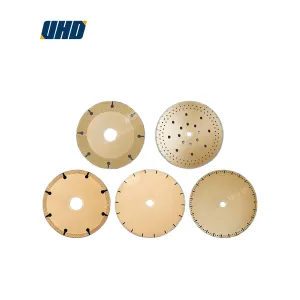
In addition, the saw blade is also designed with safety features such as anti - vibration grooves and heat - dissipation holes. The anti - vibration grooves can reduce the vibration of the saw blade during cutting, improving the cutting accuracy and reducing operator fatigue. The heat - dissipation holes can effectively dissipate the heat generated during cutting, preventing the saw blade from overheating and extending its service life.
There are a variety of specifications and tooth types available in the market to meet different user needs. For example, saw blades with a larger diameter (such as 12 - inch or 14 - inch) are suitable for large - scale cutting projects, such as cutting large - area granite slabs in construction sites. Smaller - diameter saw blades (such as 4 - inch or 6 - inch) are more suitable for precision cutting in workshops, such as cutting small ceramic tiles.
Different tooth types also have different application scenarios. Continuous - rim tooth types are suitable for cutting hard and brittle materials, providing a smooth cutting surface. Turbo - rim tooth types are ideal for cutting soft materials, as they can quickly remove large amounts of material and improve cutting efficiency.
Let's take a granite processing factory as an example. When they need to cut a large number of granite slabs every day, they should choose a 14 - inch saw blade with a continuous - rim tooth type. This combination can ensure high - speed and high - quality cutting, improving production efficiency. On the other hand, a small - scale tile workshop that focuses on fine - detailed cutting should opt for a 6 - inch saw blade with a segmented tooth type for better control and precision.

 484
|
484
|
 vacuum brazed diamond drill bits
diamond drill bit manufacturing process
drill bit durability improvement
rock core drilling performance
dry drilling applications
404
|
vacuum brazed diamond grinding wheel
eco-friendly grinding tools
high-efficiency metal machining
green manufacturing technology
superhard cutting tools
90
|
vacuum brazed diamond wheel
cast iron grinding solution
automatic grinding diamond wheel
high precision grinding
superhard tool replacement
224
|
efficient diamond grinding wheels
industrial grinding efficiency
dust control grinding wheels
superhard tool applications
metal processing solutions
283
|
Vacuum brazed diamond grinding wheels
Metal processing efficiency
Multi - axis automatic grinding
Cast iron processing wheels
Superhard tools
vacuum brazed diamond drill bits
diamond drill bit manufacturing process
drill bit durability improvement
rock core drilling performance
dry drilling applications
404
|
vacuum brazed diamond grinding wheel
eco-friendly grinding tools
high-efficiency metal machining
green manufacturing technology
superhard cutting tools
90
|
vacuum brazed diamond wheel
cast iron grinding solution
automatic grinding diamond wheel
high precision grinding
superhard tool replacement
224
|
efficient diamond grinding wheels
industrial grinding efficiency
dust control grinding wheels
superhard tool applications
metal processing solutions
283
|
Vacuum brazed diamond grinding wheels
Metal processing efficiency
Multi - axis automatic grinding
Cast iron processing wheels
Superhard tools







.png?x-oss-process=image/resize,m_fill,h_300,w_300/format,webp)
.png?x-oss-process=image/resize,m_fill,h_300,w_300/format,webp)


