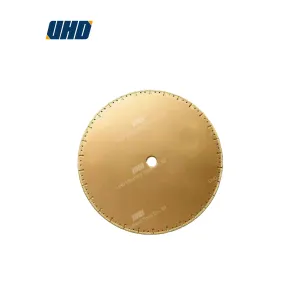
When selecting diamond saw blades for construction or stone fabrication, you may often face issues like low cutting efficiency, short blade lifespan, or frequent chipping. These challenges significantly impact productivity and operating costs. Understanding the critical materials and manufacturing technologies behind vacuum sintered diamond blades can empower you to make scientifically informed decisions that enhance cutting performance and safety.
The heart of a high-performance vacuum sintered diamond blade lies in its diamond particulates and substrate matrix. High-quality synthetic diamonds with uniform particle size distribution offer superior hardness and wear resistance, which directly translates to longer blade life. Gold-standard particles often range around 10-30 microns, balancing sharpness and toughness.
The substrate usually comprises tungsten carbide or similar hard alloys, providing essential cutting stability and vibration damping. A tungsten carbide base with a hardness of HRC 85 or above generally ensures durability in heavy-duty applications. The synergy between diamond grit and tungsten carbide structure determines resistance to abrasion and thermal stress.
Vacuum sintering technology utilizes a controlled low-pressure, high-temperature environment to fuse diamond particles to the substrate without oxidation, which is a key difference compared to traditional brazing or infiltration techniques. This process enhances diamond retention and improves bond homogeneity, resulting in a more stable cutting edge.
On top of sintering, laser welding is increasingly applied to join the diamond segments with the core. Laser welding creates an extremely strong metallurgical bond, reducing segment detachment risk during high-speed operations. Data from industry tests indicate that laser-welded blades exhibit up to 20% longer service life under similar cutting loads.
| Parameter | Vacuum Sintering | Traditional Brazing |
|---|---|---|
| Diamond Retention Strength | High (≥ 90 MPa) | Moderate (≈ 70 MPa) |
| Corrosion Resistance | Excellent | Fair |
| Bond Uniformity | Very Uniform | Variable |
| Thermal Stability | Up to 1200°C | Up to 900°C |
Your blade choice must match your equipment and application. For instance:
The interplay between these factors influences cutting efficiency and safety margins, so selecting blades based on your cutting thickness and machine RPM optimizes operation results.
Different substrates require specific blade characteristics:
Ensuring operator safety means choosing blades with certified explosion-proof design. Multi-layered structural reinforcements and balanced segment layouts minimize the risk of catastrophic failure. Meet or exceed industrial standards like EN13236 and OSHA guidelines for blade safety to ensure your compliance and worker protection.
Investing in vacuum sintered blades with enhanced durability reduces downtime and maintenance costs. In high-demand environments, such blades can maintain consistent cutting rates 15-25% longer compared to lower-tier alternatives, directly improving operational ROI.

 104
|
104
|
 vacuum brazed diamond grinding wheel
metalworking efficiency improvement
ultra-hard tool grinding wheel
extended tool life
high-precision grinding
383
|
vacuum brazed drill bit
diamond core drill bit
natural stone drilling
concrete drilling tools
UDD020 performance
162
|
vacuum brazed diamond wheel
automatic grinding wheel
diamond grinding tool for cast iron
customizable diamond grinding wheel
export competitive grinding tools
287
|
vacuum brazed drill bits
diamond core drill bits
abrasive grade impact
drill bit durability
dry drilling tools
305
|
Brazed diamond grinding wheels
Environmentally - friendly manufacturing
Green processing
Ductile iron precision machining
Low - dust grinding wheels
vacuum brazed diamond grinding wheel
metalworking efficiency improvement
ultra-hard tool grinding wheel
extended tool life
high-precision grinding
383
|
vacuum brazed drill bit
diamond core drill bit
natural stone drilling
concrete drilling tools
UDD020 performance
162
|
vacuum brazed diamond wheel
automatic grinding wheel
diamond grinding tool for cast iron
customizable diamond grinding wheel
export competitive grinding tools
287
|
vacuum brazed drill bits
diamond core drill bits
abrasive grade impact
drill bit durability
dry drilling tools
305
|
Brazed diamond grinding wheels
Environmentally - friendly manufacturing
Green processing
Ductile iron precision machining
Low - dust grinding wheels






.png?x-oss-process=image/resize,m_fill,h_300,w_300/format,webp)